
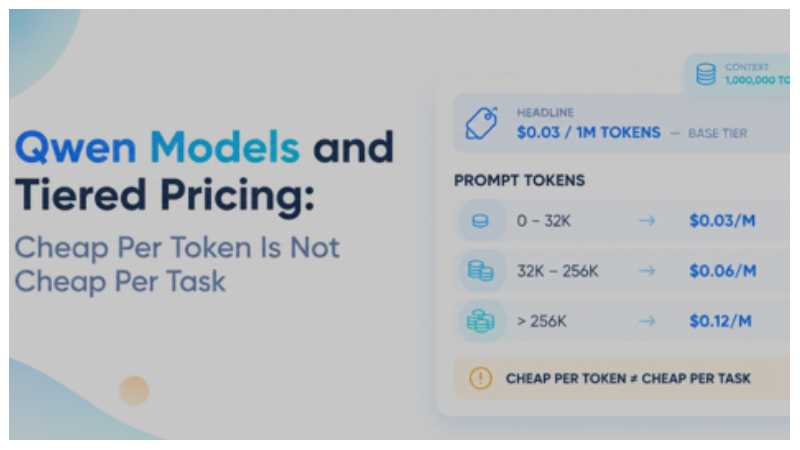
$0.03 per million input tokens is a headline, and like most headlines it is a base tier. The model page for Qwen3.7 Flash lists that rate, and then it prints the fine print: pricing is tiered by prompt length, costs step up above 32K and again above 256K input tokens, and batching short requests is materially cheaper than padding long ones [VENDOR]. So the cheapest per-token number in the Qwen catalogue has a staircase attached to it, and the sentence this article is about is the difference between the top step and the bottom one [OURS]. Routing model calls through OrcaRouter‘s Qwen models catalogue keeps the provider’s tiering intact — the rate card bills exactly what the provider publishes [OURS].
The staircase in plain numbers
The tiering applies to prompt tokens, and it changes the arithmetic of a single request. A short prompt — a few thousand tokens — stays on the $0.03 base tier for its input, at $0.13 per million output tokens [VENDOR]. A prompt that crosses 32K input tokens steps up to a higher per-million rate. A prompt that crosses 256K input tokens steps up again [VENDOR]. The page does not print the two higher rates on the model page itself; what it commits to is the shape — two thresholds, two steps, with the base tier applying only below the first one [VENDOR]. Because the thresholds are about input length, they also interact with the model’s own envelope: 1,000,000 tokens of context on the model page, with a maximum output of 65,536 tokens [VENDOR]. A 1M-token window is precisely the territory where the second and third tiers live, which is the honest warning in the fine print: the models that can hold the most are the models most likely to cross the thresholds [OURS].
The practical consequence is a batching habit, and the page names it directly: batching short requests is materially cheaper than padding long ones [VENDOR]. A pipeline that concatenates everything into one giant prompt pays the top tier for the whole thing; a pipeline that sends a batch of short prompts pays the base tier for each [OURS]. The same work can sit on different steps of the staircase depending on how it is shaped, which is exactly why “cheapest per token” and “cheapest per task” are different questions [OURS].
Two calibres, again
The context figure needs the same care it needed for Qwen3.8 Max. On this model page, the context is 1,000,000 tokens — the model-page calibre [VENDOR]. The provider page’s FAQ, on a different model, speaks of 1048K tokens for Qwen3.6 Plus [VENDOR]. These are two pages and two numbers, and the rule is to say which page each came from rather than blend them [OURS]. The model-page calibre is what belongs next to this model’s name; the FAQ calibre belongs to its own conversation [OURS].
The per-task arithmetic
Now the arithmetic the headline hides. Compare Qwen3.7 Flash with the catalogue’s flagship, Qwen3.8 Max, at $2.00 per million input tokens and $6.00 per million output tokens [VENDOR]. On short prompts, the flash model is dramatically cheaper — roughly 67x on input at the base tier, a factor that only widens the smaller the prompt is [OURS]. On a long prompt that crosses 256K, the flash model has stepped up twice, and while the exact stepped rate is not printed on the model page, the delta between base tier and top tier is what the staircase is for [OURS]. The flagship, by contrast, has no tiering on its page: the $2.00/$6.00 rate is flat, with no threshold mentioned [VENDOR]. So the per-task comparison inverts by shape: the flash model is cheap until a prompt grows long, and the flagship is flat at a higher level. Which one is “cheaper” is a function of prompt length, not of the headline number [OURS].
There is a qualitative layer on the same rows. The model page assigns Qwen3.7 Flash a quality score of 7 out of 10, a composite OrcaRouter computes for its own catalogue; Qwen3.8 Max sits at 9 out of 10 [OURS]. The price gap at the base tier buys a quality gap, and neither number is independent of the other [OURS]. Latency is published for the flash model — a time-to-first-token of 4.18 seconds at p50, which is 4,180 ms converted from the seconds the model page prints [VENDOR]. For the flagship, no latency figure is provided by the page’s own statement [VENDOR].
Whether the staircase actually costs you anything is measurable before you commit to the model. Take a week of production prompts and look at how their input lengths distribute: a pipeline whose median sits at a few thousand tokens and whose long tail stops below 32K never leaves the base tier, while a document-analysis pipeline whose median input sits at 60,000 tokens pays a stepped rate on most of its calls [OURS]. The thresholds are published, the request lengths are already in your own logs, and the join between the two is arithmetic — which makes the tiering one of the few catalogue properties a team can cost exactly rather than estimate [OURS].
What “cheapest” means on the provider page
The provider page adds its own layer of cheap. It counts 27 models in the Qwen catalogue, with a cheapest input rate of $0.100 per million tokens on qwen/qwen3.5-flash — a different row from the flash model this article is about [VENDOR]. The census is heavily visual: 22 of the 27 models carry vision, with 24 on tools, 23 on reasoning and 24 on JSON mode [OURS]. The catalogue median p50 is 4,000 ms [OURS]. None of these figures contradict the staircase; they are the surrounding context that makes the staircase legible [OURS].
The takeaway
The takeaway is the sentence the model page itself writes: batching short requests is materially cheaper than padding long ones [VENDOR]. $0.03 per million input tokens is the base tier, not the price; the staircase steps up above 32K and again above 256K, and a 1,000,000-token context window is exactly where the top steps live [VENDOR]. Per token, Qwen3.7 Flash looks like the obvious buy next to Qwen3.8 Max’s flat $2.00/$6.00 [VENDOR]; per task, the answer depends on how long your prompts run, which is why the two questions deserve different words [OURS]. Read the base tier as a base tier, check the thresholds against your prompt lengths, and let the fine print — the page’s own fine print — make the call for you [OURS].
Sourcing note: the $0.03/$0.13 rates, the tiered-pricing statement (steps up above 32K and again above 256K input tokens, batching short requests being materially cheaper), the 1,000,000-token context and 65,536-token maximum output, and the 4.18 s p50 time-to-first-token for Qwen3.7 Flash are all read from OrcaRouter’s own qwen3.7-flash model page on 2026-10-15 [VENDOR], as are the Qwen3.8 Max flat $2.00/$6.00 rates, its missing latency figure, and the FAQ’s 1048K-token context for Qwen3.6 Plus [VENDOR]. The 27-model count, the vision/tools/reasoning/JSON census (22/24/23/24), the $0.100/M cheapest input on qwen3.5-flash, the 4,000 ms p50 catalogue median and the quality scores (7/10 for Qwen3.7 Flash, 9/10 for Qwen3.8 Max) are OrcaRouter’s own catalogue data [OURS]. The 4,180 ms conversion and the per-task comparisons are my own arithmetic on those published numbers [OURS]. No third-party benchmark or market figures are used. Catalogue figures are rolling and will drift. Read 2026-10-15.