
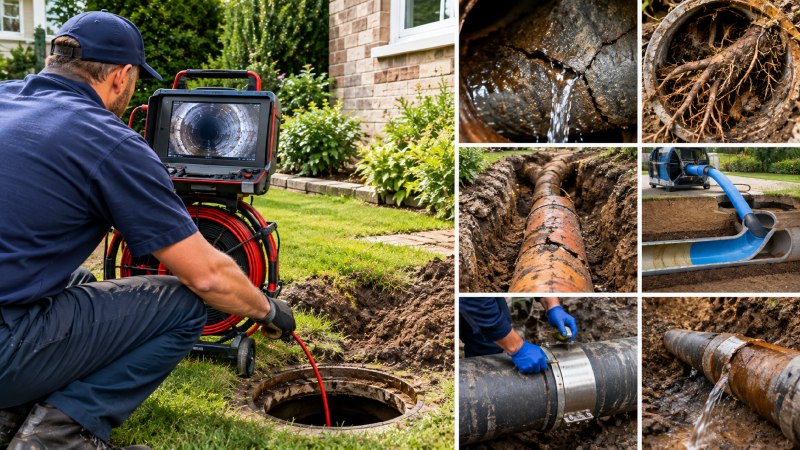
Nobody really thinks about their sewer pipe until there is a problem with it. Most of the time, it’s buried underground and quietly doing its job. Then one day the basement drain starts backing up, the yard develops a strange wet spot, or the whole house seems to be draining slower than usual. When that happens, sewer repair in Toronto may be needed, but the first step is often a sewer camera inspection to find out what’s actually happening underground. A burst sewer pipe can cause a lot of damage if it isn’t dealt with quickly, but cracks, collapsed sections and even a leaking sewer joint can cause many of the same warning signs.
How Do You Know If Your Sewer Pipe Has Burst?
The obvious sign is sewage coming back into the house. Unfortunately, that’s also one of the messier signs.
There are some less dramatic clues that can show up first. You might notice that several drains are slow at the same time, your toilet makes a strange gurgling sound, or there is a sewage smell around the basement or outside the house.
Your yard can tell you a few things too. A patch of grass that suddenly looks much greener than everything around it, soggy ground when it hasn’t rained, or water collecting in one particular area could indicate that something is happening underground.
None of these signs proves that the sewer pipe has burst. A blockage can cause some of the same symptoms. That’s why it’s better to investigate rather than assume the worst.
Why Do Sewer Pipes Burst?
There isn’t one reason sewer pipes fail.
Age is a big one. Older pipes can gradually weaken from corrosion, soil movement and years of use. Some older materials are simply more vulnerable to deterioration than newer sewer piping.
Tree roots are another common headache. If there is already a small crack or opening around a pipe joint, roots can find their way in. Once they’re inside, they can grow and restrict the flow of wastewater. Over time, that pressure and damage can make an existing problem considerably worse.
Ground movement can also affect underground pipes. Toronto homes and properties aren’t all sitting on exactly the same soil conditions, and pipes can shift or separate as the ground around them moves.
Then there are blockages. A severe blockage can increase pressure in a compromised section of pipe and contribute to a failure.
Sometimes the pipe is simply old and worn out.
A Leaking Sewer Joint Can Be a Warning Sign
A sewer line doesn’t have to crack right down the middle to cause trouble.
The joints connecting sections of pipe can deteriorate or separate. When that happens, wastewater may escape into the surrounding soil, while soil and groundwater can enter the sewer line.
You may not notice this right away. There might not be a dramatic leak inside your house. Instead, you could have recurring backups, unpleasant odours or unexplained wet areas outside.
If a sewer joint is already showing signs of failure, it’s worth finding out what condition the rest of the line is in. Repairing one joint on an otherwise healthy pipe is one thing. Repairing one joint when several other sections are badly deteriorated is another.
Why a Sewer Camera Inspection Is Often the First Step
This is where a sewer camera inspection can save a lot of guesswork.
Rather than immediately digging up a driveway or basement floor, a camera can be sent through the sewer line to see what’s actually going on inside. It can show cracks, roots, corrosion, separated joints, blockages and collapsed sections that would otherwise be impossible to see without excavation.
More importantly, it helps locate the problem.
That’s useful because you don’t want to dig up half your property only to discover that the actual problem was a few feet away from where you expected it to be.
A camera inspection also gives a better basis for deciding whether you need a localized repair, pipe lining, trenchless replacement or traditional excavation.
What Should You Do If You Suspect a Burst Sewer Line?
Start by reducing water use in the house.
Don’t keep flushing toilets or running the washing machine just because the backup seems to have stopped. If the sewer line is damaged or blocked, adding more water can make the situation worse.
If sewage has already entered the basement or another part of the home, keep children and pets away from the affected area. Sewage isn’t something you want to be cleaning up casually.
Then call a professional for an assessment.
If you can catch the problem before the pipe completely collapses, you may have more repair options available.
Does a Burst Sewer Pipe Mean You Need to Dig Up the Yard?
Not always.
Traditional sewer replacement involves excavating down to the damaged pipe, removing the old section and installing new piping. It’s a proven approach, but it can also mean disturbing landscaping, driveways, walkways or other finished areas.
That’s one reason trenchless sewer methods have become more popular.
Depending on the condition and layout of the existing sewer line, trenchless techniques can sometimes repair or replace the pipe with considerably less excavation.
For a homeowner, that can mean less disruption and potentially less restoration work afterward.
But trenchless isn’t automatically the right answer either. A severely collapsed or otherwise unsuitable pipe may need a different approach. You really need to know what’s happening underground first.
What Are Your Sewer Repair Options?
Once the problem has been identified, the repair can be planned around the actual condition of the pipe.
Repairing a Section
If there is one damaged area and the rest of the sewer line is in good shape, repairing that section may be enough.
There isn’t much point in replacing an entire sewer line that is otherwise healthy because of one isolated failure.
Pipe Lining
Pipe lining is another option for certain damaged sewer lines. Instead of removing the entire existing pipe, a new liner is installed inside it and cured in place.
The result is essentially a new pipe inside the old one.
This can be particularly useful where excavation would be difficult or disruptive. Whether a line can be lined depends on its condition, size, shape and the extent of the damage.
Trenchless Sewer Replacement
If the existing pipe is too damaged for lining, trenchless replacement may be considered.
This approach can replace the old sewer line while limiting the amount of surface excavation needed. It isn’t suitable for every property, but it can be a very practical option when the conditions are right.
Traditional Replacement
Sometimes digging is unavoidable.
If a section has completely collapsed or there are other site-specific issues, traditional excavation may be the most sensible solution. It may not be the most exciting option, but the goal is to fix the sewer properly, not simply choose the method with the fanciest name.
How Urgent Is a Burst Sewer Pipe?
Pretty urgent.
If sewage is backing up into your home, you don’t want to wait a few days to see whether it clears itself. Even when the water eventually drains away, the underlying problem hasn’t necessarily gone anywhere.
The same applies to repeated backups. If you’ve had the sewer line cleared several times and the problem keeps coming back, there may be something more serious happening in the pipe itself.
Getting the line inspected can tell you whether you’re dealing with another blockage or a deteriorating sewer line that needs actual repair.
Can You Prevent a Sewer Pipe From Bursting?
You can’t prevent every sewer failure, especially with older pipes, but you can make it less likely that a small problem turns into a major one.
Pay attention to recurring drainage issues rather than treating them as normal. If drains are constantly backing up, there’s usually a reason.
Be careful about what goes down your drains too. Grease, wipes and other materials that don’t break down properly can contribute to blockages.
If you have large trees near the sewer line, roots are worth keeping in mind as well. And during a particularly cold Toronto winter, taking steps toward protecting pipes from freezing is another sensible part of general plumbing maintenance.
For older properties, periodic inspections can also be worthwhile, particularly if the sewer line has never been inspected or you’ve started noticing changes in drainage.
The Bottom Line
A burst sewer pipe is never good news, but it doesn’t necessarily mean your property needs to be torn apart.
The first thing to figure out is what has actually failed.
A sewer camera inspection can provide a clear picture of the line and help identify everything from a leaking joint to root intrusion or a collapsed section. From there, you can look at the appropriate sewer repair in Toronto, whether that’s a localized repair, pipe lining, trenchless replacement or traditional excavation.
The important thing is not to ignore the warning signs. A small sewer problem is usually easier to deal with than the same problem after it has turned into a full-blown backup.