
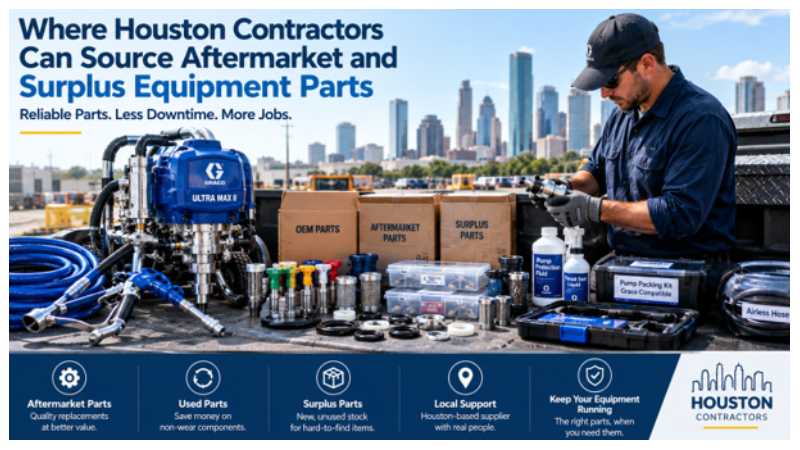
Contractors in the Houston area work in some of the most demanding conditions in the country: humid air most of the year, salt air near the coast and a hurricane season that brings a surge of repair work every summer and fall. Equipment works hard here, and parts wear out on a steady schedule. When a pump packing or a gun seal fails in the middle of a job, the question is where to get the right part, quickly, at a fair price and from a source you can trust.
This guide sets out the sourcing options available to Houston contractors, explains what aftermarket, used and surplus parts actually are, and gives a short checklist for vetting any supplier. It is written by a Houston parts supplier, so we will be clear about where it matters, but the advice applies to whoever you buy from.
Key takeaways
- You have five main sources: manufacturer dealers, local equipment shops, online suppliers, used and surplus sellers and the manufacturer direct.
- Aftermarket parts are made by someone other than the original manufacturer to replace a named OEM number. Used parts come from other machines. Surplus parts are typically new, unused stock.
- Match parts by OEM number and model, not by appearance.
- Vet any supplier on five things: clear part numbers, written return terms, real phone support, honest shipping estimates and plain labeling of what a part is.
- Order wear parts before storm season, not after.
Why sourcing matters more on the Gulf Coast
Two local conditions affect how you buy parts.
- Humidity and salt air. Damp air corrodes fittings, filters and bare steel on a pump. Wear parts and rubber seals need replacing more often than they do in a dry climate.
- Hurricane season. From June through November, storm repair can arrive all at once, and every contractor in the region is buying the same parts. Lead times lengthen exactly when you need them shortest.
Both argue for the same habit: know where your parts come from before you need them, and keep a short list of spares for the equipment you rely on.
Your five sourcing options
| Source | Strengths | Watch out for |
| Manufacturer dealer | Original parts, authoritative advice, warranty-safe for covered machines | Highest prices; stock can be limited; special orders take time |
| Local equipment shop or rental counter | Immediate pickup for common items; face-to-face help | Limited range; may not stock older models or specialty parts |
| Online aftermarket supplier | Wide range; listings that cross-reference OEM numbers; lower prices on many wear parts | Quality varies; check labeling, return terms and shipping time |
| Used and surplus sellers | Savings on non-wear parts; access to discontinued items | Condition varies; wear parts are better bought new |
| Manufacturer direct | Authoritative; sometimes the only source for new models | Slower for older or niche items; fewer options on price |
No single source wins every time. A sensible approach is to use a dealer or the manufacturer for warranty-covered machines and critical parts, a local shop for same-day needs, and an online aftermarket supplier for regular wear parts and spares.
What aftermarket, used and surplus really mean
The words are used loosely, so it is worth pinning them down.
- Aftermarket: a part made by a company other than the original manufacturer, designed to replace a named OEM part. A good listing states the OEM number it replaces. Brand names in the listing identify the machine it fits and do not mean the original brand made it.
- Used: a part taken from another machine. Condition varies, so the listing should say what you are getting.
- Surplus: typically new, unused stock that has been left over, often from older or discontinued models.
Used and surplus parts are often the best route for items that do not wear in normal use, such as housings and covers, and for older equipment whose parts are no longer made. Used and surplus parts are worth a look when a part is hard to find. Wear parts such as packings, o-rings and seals are better bought new, because their condition is what matters most.
A frank word about warranty
If a machine is under warranty, the safest move is to ask the manufacturer before you repair it with aftermarket parts. Manufacturers such as Graco state that their warranties exclude damage caused by substituting non-original parts. Federal law in the United States generally limits how far a manufacturer can tie a consumer-product warranty to branded parts, but a manufacturer can deny coverage for damage an aftermarket part actually caused. For equipment out of warranty, the choice is yours. A reputable aftermarket supplier will be straightforward about all of this and will not claim approval from the original manufacturer.
How to vet any parts supplier
- Clear part numbers. The listing should show the OEM number it replaces and, for aftermarket parts, the maker’s own number. If there is no number, be careful.
- Plain labeling. It should say whether a part is aftermarket, used or surplus, and give the condition for used items.
- Written return terms. Read them before you buy. Look at the time limit, who pays shipping, any restocking fee and what cannot be returned.
- Real phone support. Call with a question. Someone who can confirm a fit before you pay is worth more than a lower price.
- Honest shipping estimates. Ask when the order will be processed, how it ships and what the realistic delivery window is.
A related tip: the cross-reference is the most useful tool in aftermarket buying. If you know the OEM number from the old part, a cross-reference to the aftermarket equivalent tells you what the replacement is, and who makes it.
How we do it, as one example
We should declare an interest here: eRepairCenter is a Houston company, and the author of this article works there. We supply aftermarket, used and surplus replacement parts for airless paint sprayers and related equipment, and we are an authorized Bedford Precision distributor. Orders ship across the United States. In plain terms, this is how it works:
- Orders placed by 12:00 PM Eastern are processed the same business day.
- Most orders over $200 ship by UPS and smaller orders typically by USPS. Delivery usually takes three to four business days, which is an estimate that varies with location, weather and carrier. In many cases an order is drop-shipped directly from the manufacturer.
- Hoses are heavy and bulky, so each one needs a custom shipping quote.
- New, unopened parts can be returned within 30 days of delivery with a return authorization. Return shipping may be the buyer’s cost, a restocking fee of up to 30 percent may apply depending on the reason, and opened or installed electrical parts cannot be returned.
- Parts are aftermarket, used or surplus unless a listing says otherwise. We are an independent supplier, and brand names appear only to show what a part fits.
You can compare those terms with any other supplier using the checklist above. If another supplier is clearer, faster or cheaper for the part you need, buy from them. What matters is that the part is right and the terms are clear.
Build a pre-storm parts list
The best time to buy parts is before they are urgent. For airless sprayers and similar equipment, a simple pre-storm list covers the failures that stop work:
- Gun filters and an inlet strainer for each sprayer
- Spare spray tips in the sizes you use
- An o-ring and seal set
- A pump packing kit for each pump model
- A spare hose or whip hose
- Pump protection fluid and throat seal liquid, if your pump uses them
Write the model and part numbers on the list, and keep it with the equipment. When a storm brings a surge of work, your spares are already in the truck.
Frequently asked questions
Are aftermarket parts as good as original parts?
It depends on the maker. Many aftermarket parts are well made, and some are not. The sensible approach is to buy from a supplier that is clear about what it sells, match the OEM number and specification, and check the return terms in case a part does not perform.
Is it safe to buy used equipment parts?
For non-wear parts, often yes, provided the listing describes the condition. For wear parts such as packings and seals, it is better to buy new.
What information do I need to order a part?
The OEM part number on the old part is best. If it is worn off, use the machine’s model and series from the ID plate, the parts list in the manual and a photo of the part. A good supplier will help you identify it before you pay.
Can I return a part that does not fit?
That depends on the supplier’s terms, which is why they should be in writing. Always check the time limit, the shipping cost and any restocking fee before you order.
Questions to ask when you call a supplier
A short phone call tells you a great deal about a supplier. These are worth asking, whoever you are buying from.
- “Can you confirm this part fits my model?” Give the model, series and pump number from the ID plate. A good supplier will check rather than guess.
- “Is this part aftermarket, used or surplus?” The answer should be immediate and specific.
- “What is the OEM number this replaces?” It should match the number on your old part.
- “What is the return policy if it does not fit?” Ask about the time limit, the shipping cost and any fee.
- “When will it ship, and how long will it take?” You want a cut-off time, a carrier and a realistic estimate rather than a promise.
- “Does it ship direct from you or from the manufacturer?” It affects timing, and a straight answer is a good sign.
Order early, especially before storms
The weeks before and after a major storm are the hardest time to buy parts. Demand rises, carriers are delayed and the supplier’s own stock can run short. If you work in the Houston area, make the pre-storm list part of your spring routine: check the equipment you rely on, write down the wear parts it needs and order them while shipping is still predictable. It is a small habit that spares you a long wait in the busiest weeks of the year.
The short version
Know your sources, understand what the words aftermarket, used and surplus mean, and vet any supplier on labeling, return terms, phone support and shipping honesty. Keep a short spares list for storm season, and match parts by OEM number and model. Do those things, and the next time a part fails on a Houston job, you will know exactly where to turn.
About the author
The eRepairCenter parts team helps painters, contractors and maintenance crews identify and replace worn parts on airless paint sprayers. eRepairCenter is a Houston, Texas supplier of aftermarket, used and surplus replacement parts and an authorized Bedford Precision distributor, shipping across the United States. Phone 713-931-0006.